Planning · Assets · Systems · Execution
An internal framework for companies to manage projects and initiatives - four stages that take any initiative from an agreed outcome to work that runs.
The problem
Most projects don't fail inside a stage. They fail at the handoffs between them.
A team agrees on a goal and starts assigning tasks the same afternoon. Two weeks later, half the work is stalled waiting on something nobody planned to make. The launch happens anyway, once, and then decays because nothing keeps it running.
I designed and built PASE to give companies a shared way to manage projects and initiatives so that doesn't happen. Four stages, in order, each producing the thing the next one depends on.
How companies use it
PASE runs inside an organization - for a single project, a department initiative, or a company-wide rollout. Every stage has a clear output and a check before moving on, so everyone involved shares the same language for where an initiative stands and what it needs next.
The four stages
P · Stage 1
Planning
What are we actually trying to accomplish, and how will we know?
Define the outcome before the activity. What does done look like, by when, within what constraints - and just as important, what's out of scope. A plan isn't a task list. It's the agreement that every later decision gets checked against.
- You produce
- A one-page plan - outcome, how success is measured, deadline, constraints, and what we're explicitly not doing.
- You're ready to move on when
- Anyone involved can explain the goal in one sentence, and they'd all say roughly the same sentence.
- If you skip it
- Lots of motion in roughly the right direction, and a finish line that keeps moving.

A · Stage 2
Assets
What has to exist before this can work?
List everything the plan depends on - content, tools, accounts, data, templates, approvals, access, budget - then mark each one: have it, build it, buy it, or borrow it. Then go develop what's missing. This is where most projects are actually won or lost, because it's where the hidden work becomes visible.
- You produce
- An asset inventory with a status on every line, and the missing assets built.
- You're ready to move on when
- Nothing on the critical path says "TBD."
- If you skip it
- Execution starts on time and stalls a week later, waiting on something nobody was making.

S · Stage 3
Systems
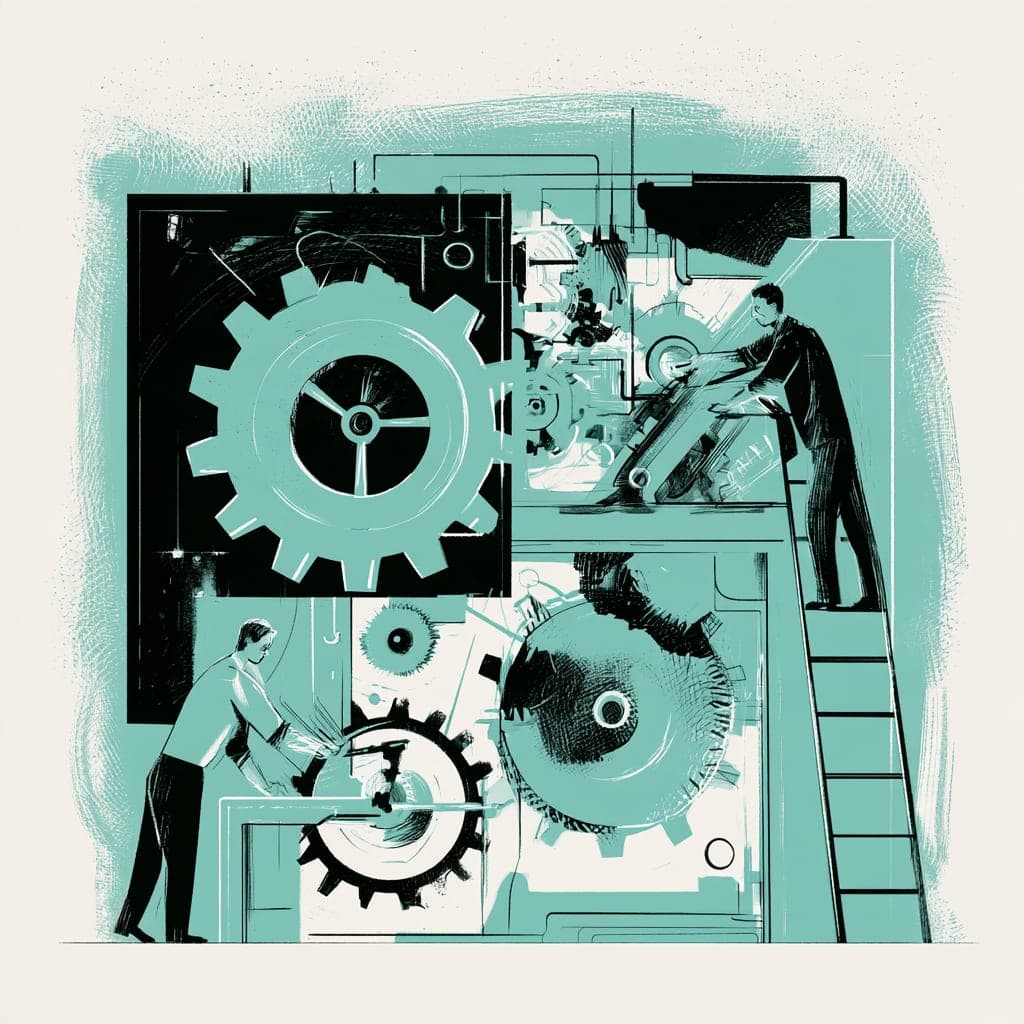
What keeps this running after launch day?
Design how the work operates on an ordinary Tuesday, not just how it gets launched. Cadence, workflow, where things live, what triggers what, what gets automated, and how status gets reported. A project without a system is an event. A project with one is an operation.
- You produce
- The operating system - the workflow, the cadence, the tools and automations, and the reporting loop.
- You're ready to move on when
- The work could run for a month without anyone needing a meeting about how it's supposed to work.
- If you skip it
- It ships once, looks great, and quietly decays.
E · Stage 4
Execution
How does the work get delivered, and how will we know it is on track?
Run the work through the system you designed. Assign responsibilities, set the update cadence, and track progress against the plan so problems surface early. This is where the earlier stages pay off: the outcome is clear, the inputs exist, and the process is already defined.
- You produce
- A delivery plan - who's doing what, the update cadence, and how progress is tracked against the plan.
- You're ready to move on when
- Progress is visible against the plan, and issues surface before deadlines instead of after.
- If you skip it
- Work happens, but nobody can say whether it's on track until it's late.
Worked example: launching a new client onboarding process
An illustrative example of one initiative run through PASE: a company replacing an ad-hoc, inbox-driven client onboarding with a consistent process.
- Planning
- Outcome: every new client is fully onboarded within ten business days of signing, with no missing information. Measured by: days from signature to kickoff, and how often the team goes back to the client for something it should already have. Out of scope: changing pricing or the sales process.
- Assets
- An intake form, a welcome packet, a kickoff deck template, access checklists for each tool, and a shared client folder structure. Already had: the kickoff deck. Built: the intake form and access checklists. Borrowed: the folder structure from the finance team.
- Systems
- A signed contract triggers the intake form automatically. Answers flow into the project tool and create the onboarding tasks. A weekly onboarding check-in covers every client in progress, and a simple dashboard shows where each one stands.
- Execution
- The team runs new clients through the process. Each step has a clear responsible person, progress shows on the dashboard, and the weekly check-in catches anything stuck before the ten-day mark.
When not to use PASE
- Small tasks. If it takes an hour, just do it. The overhead isn't worth it.
- Real emergencies. Fix it first. Run PASE afterward on whatever needs to become repeatable so it doesn't happen again.
- Pure exploration. When you genuinely don't know what the outcome should be, prototype first. PASE starts once you know what you're aiming at.
How to tell if it's working
These are the signals I watch. I don't have measured results to publish yet, and I won't claim any until I do.
- Fewer tasks stalled waiting on an input nobody planned for.
- Recurring work running without someone re-explaining how it works.
- Status surfaces before a deadline instead of after it.
- The time between "approved" and "actually live" getting shorter.
Why PASE exists
Project management is something most companies and organizations struggle with - not because their people aren't capable, but because they don't have an internal system for getting initiatives done. Every project gets planned differently, depends on whoever happens to be leading it, and loses momentum once the launch is over. PASE is that internal system: one shared way to plan an initiative, build what it needs, design how it will run, and deliver it.